“I work in the space between creation and destruction.”
— Rei Kawakubo
⚡ [A: A Beginning Wrapped in Silence]
Tokyo, late 1960s.
A city humming with postwar ambition.
And in one small room, a woman working alone — not sketching for attention, but for truth.
- Her name: Rei Kawakubo
- Her vision: Clothing that questions, not decorates
- Her brand: Comme des Garcons — French for “like some boys”, hinting at gender rebellion even before it was spoken aloud.
Rei wasn’t trained as a designer; she studied fine art and literature.
Her approach was not about fashion — it was about philosophy in fabric.
She wasn’t chasing beauty.
She was deconstructing it.
🖤 [B: Breaking the Rules Before America Knew Her Name]
By the early 1970s, Comme des Garcons had already become Tokyo’s most whispered secret.
It was stark, anti-trend, monochromatic — and magnetic.
The brand’s visual language:
- Black and gray palettes (symbolizing purity through absence).
- Asymmetrical cuts (rejecting perfection).
- Fabrics wrinkled, unfinished, and torn (because imperfection was honesty).
When the first collection reached Europe in 1981 — and later, New York City — fashion editors were stunned.
“Poverty chic,” one called it.
“A new modernism,” said another.
“A revolution,” whispered a few.
Rei wasn’t there to please the Western eye.
She was there to mirror it — and expose how shallow it had become.
🕊️ [C: Comme Arrives in America — A Quiet Explosion]
1981: Comme des Garcons steps into the U.S. market.
It’s not loud.
It’s not marketed.
It simply exists — quietly, like an idea that waits for you to notice it.
In a decade defined by shoulder pads and sequins, Rei’s all-black collections were heresy.
American fashion asked for glamour.
Rei offered gravity.
Her designs didn’t scream luxury; they whispered discomfort — and people leaned in to listen.
What happens when beauty no longer flatters?
When the body is abstract, and form becomes philosophy?
In that void, Rei Kawakubo found her American following — thinkers, creators, outsiders.
🎭 [D: The Boutique That Felt Like a Poem]
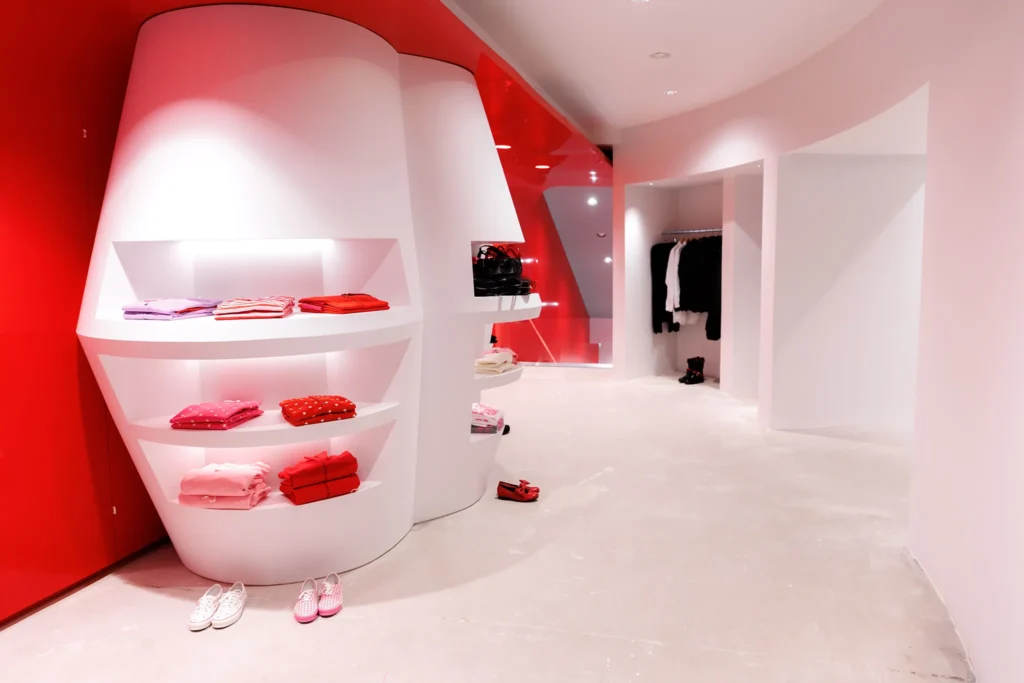
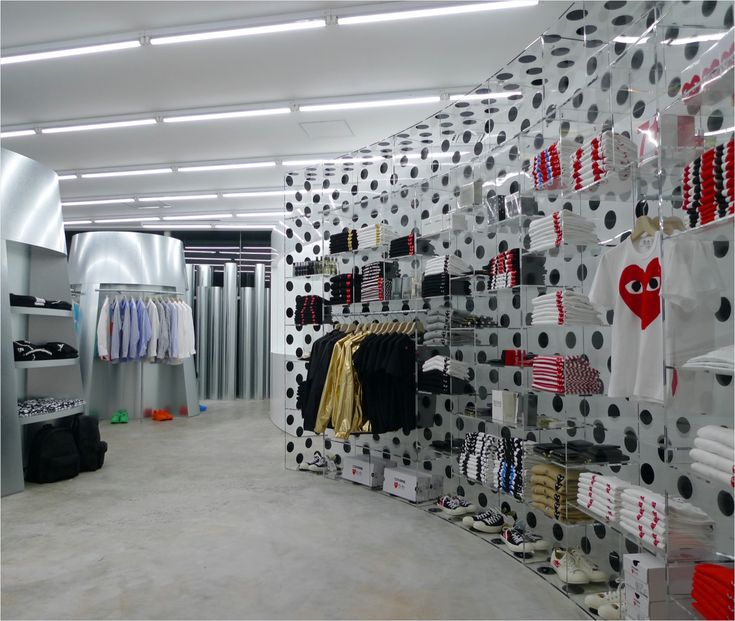
When the first Comme des Garcons store opened in New York’s SoHo, it looked more like a gallery than a shop.
No mirrors.
No mannequins.
No background music.
Instead, space — empty, clean, meditative.
- The racks: minimal, with garments arranged like thoughts.
- The light: soft but deliberate.
- The atmosphere: sacred.
You didn’t enter to “shop.”
You entered to feel.
“It wasn’t a store,” said one visitor, “it was like standing inside her mind.”
SoHo had never seen anything like it — fashion as a spatial experience, not a transaction.
❤️ [E: PLAY — The Heart That Spoke Softly]
2002 changed everything.
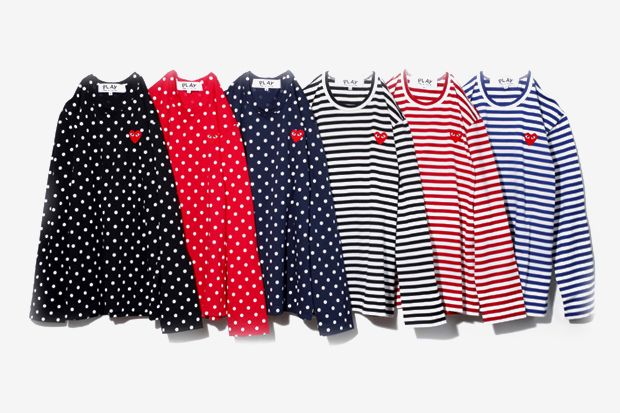
The red heart appeared — small, imperfect, wide-eyed.
Comme des Garcons PLAY launched, designed by Rei and artist Filip Pagowski.
It was a paradox:
- Simple, yet symbolic.
- Playful, yet intellectual.
- Accessible, yet elite.
🖤 Striped tees.
🖤 Minimal knits.
🖤 Converse sneakers stamped with that now-iconic heart.
PLAY bridged the gap between runway philosophy and street accessibility.
It told America:
“You can wear intelligence casually.”
In Los Angeles cafés, Brooklyn galleries, San Francisco design studios — that little heart became a quiet cultural code.
🔗 [F: Collaborations That Reshaped Culture]
Rei Kawakubo doesn’t “collaborate.”
She coexists.
Each partnership becomes a conversation, a fusion of creative minds that feel like experiments in duality.
- ⚙️ Nike x Comme des Garcons — where sport meets symbolism.
- 🔥 Supreme x CDG — streetwear meets surrealism.
- ❤️ Converse x PLAY — icon meets irony.
- 💎 Louis Vuitton x CDG — classic meets chaos.
These projects transformed how the U.S. saw fashion collaborations.
They weren’t marketing stunts — they were philosophical dialogues in cotton, rubber, and thread.
Rei’s rule: “Collaboration isn’t about compromise — it’s about coexistence.”
Each drop felt rare.
Each piece carried purpose.
🏙️ [G: Dover Street Market — Rei’s American Cathedral]
2013 → Dover Street Market New York opens.
Not a store.
Not even a concept shop.
A living, breathing organism of design.
Imagine:
- Concrete meets velvet.
- Prada beside Stüssy.
- Comme beside Gucci.
- Street next to couture.
Rei designed DSM as a “beautiful chaos” — a space where contradictions live together.
“It is about discovery, not display.”
Every season, the space changes.
Walls move. Art installations rotate.
It’s fashion in motion — just like Rei’s mind.
For American shoppers, DSM became a temple.
Not for consumption — for contemplation.
💬 [H: Rei Kawakubo — The Thinker Behind the Fabric]
You can’t talk about Comme des Garcons in the USA without talking about Rei’s philosophy.
She is:
- Reclusive, but present.
- Precise, but intuitive.
- Mysterious, but brutally honest.
Her interviews are short, her words minimal.
Yet every sentence feels carved from stone.
“I work within the space between beauty and ugliness.”
In a world of social media and spectacle, Rei remains timelessly unreadable — and that’s her greatest power.
She taught America that mystery can be more magnetic than exposure.
🧠 [I: The Art-Fashion Bridge]
In America, Rei’s influence moved beyond fashion.
It entered the realms of:
- Architecture (minimalist design, raw textures, deconstructed forms)
- Art (her garments displayed in the Met and MoMA)
- Philosophy (used as study material in fashion theory classes)
Her collections were studied like modern art — each season titled like a thesis:
“Body Meets Dress, Dress Meets Body”
“The Future of Silhouette”
“Broken Bride”
Every runway was an essay.
Every collection, a debate about what it means to be human.
⚧️ [J: Genderless Before Genderless]
Long before fashion’s obsession with “gender fluidity,” Rei had already erased the binary.
Her designs were shape-first, not sex-first.
Her garments were built for motion, not definition.
In a 1983 interview, she said:
“I design for people, not genders.”
In the U.S., this perspective resonated with a new generation — queer, questioning, expressive.
Her work became a language of liberation.
🎧 [K: From Galleries to Graffiti]
As Comme des Garcons seeped into American subculture, it morphed from high art to street identity.
- Rappers name-dropped Rei in lyrics.
- Skaters wore PLAY hearts over ripped denim.
- Photographers shot her clothes in abandoned factories.
It was no longer about owning Comme — it was about understanding it.
Streetwear wasn’t rebellion anymore; it was reflection.
🕰️ [L: The Long Shadow — Rei’s American Children]
Rei’s aesthetic became the DNA of modern American design.
Look closely, and you’ll see her fingerprints in:
- The Row (purity through restraint)
- Rick Owens (deconstruction as power)
- Fear of God (minimalist faith)
- Maison Margiela (identity through anonymity)
- Yohji Yamamoto USA presence (parallel philosophy)
All carry fragments of Rei’s rebellion.
All continue her conversation.
She didn’t teach them what to design.
She taught them how to question why they design.
🔮 [M: The Legacy — A Revolution Still Unfolding]
Decades after its arrival, Comme des Garcons in the USA remains both niche and universal.
It’s taught Americans that:
- Beauty can be uncomfortable.
- Simplicity can be radical.
- Silence can be louder than noise.
From luxury houses to thrift stores, Rei’s influence hums quietly in the background of every modern garment.
She didn’t sell to America — she rewired it.
✒️ [N: Final Reflection — The Whisper That Became an Echo]
Fashion is usually about spectacle.
But Rei’s genius lies in restraint.
She doesn’t design to be seen —
She designs to make you see differently.
“I create in order to learn what I don’t know.”
And that, perhaps, is her ultimate American gift:
the courage to keep questioning beauty in a country obsessed with it.
⚫ [O: Summary Snapshot]
| Aspect | Details |
|---|---|
| Founder | Rei Kawakubo |
| Founded | 1969, Tokyo |
| Entered U.S. Market | 1981 |
| Signature Style | Deconstruction, anti-fashion, conceptual minimalism |
| Key U.S. Presence | Dover Street Market NY, PLAY line |
| Philosophy | “Creation comes from conflict.” |
| Cultural Impact | Genderless design, streetwear fusion, avant-garde aesthetics |
🕊️ [Epilogue: The Space Between]
Comme des Garcons has never been about answers.
It’s about living inside the question —
and letting the question itself become beautiful.
In America, Rei Kawakubo didn’t just dress bodies.
She dressed ideas.
And in a world obsessed with identity, she gave us something braver —
ambiguity.
That’s her true masterpiece.