🌆 Tokyo Before the Noise
Before Tokyo became the global synonym for cool —
before the neon, the streetwear, the hype —
there was silence.
And in that silence stood a woman who refused to fit in.
Rei Kawakubo — a name whispered first, then shouted.
Not because she followed fashion,
but because she challenged its reason to exist.
In 1969, she built something that wasn’t supposed to happen.
She called it Comme Des Garcons — “like boys.”
Not about men. Not about rebellion for rebellion’s sake.
It was about being free from the weight of definition.
🖤 The Birth of a Quiet Storm
Tokyo in the late ’60s was rebuilding.
New towers rose where ashes had been.
Artists and thinkers gathered in small rooms,
speaking in questions,
dreaming of disruption.
Rei wasn’t sketching gowns — she was sketching ideas.
Her clothes ignored symmetry, rejected color, and celebrated the unfinished.
She wasn’t designing for women to be beautiful;
she was designing for women to be seen differently.
“Fashion is not about beauty,” she said. “It’s about emotion.”
Each collection felt like a poem written in fabric —
less clothing, more confrontation.
🕊️ The Crows Take Flight
In Tokyo’s narrow streets —
Harajuku, Shinjuku, Omotesando —
a tribe emerged.
They dressed in black,
their silhouettes oversized,
their movement deliberate.
They were called The Crows,
devotees of Comme Des Garcons —
outsiders who wore rebellion like second skin.
They weren’t following trends;
they were rejecting the idea that trends even mattered.
Through them, Rei Kawakubo turned fashion into a language of dissent.
⚡ 1981: Paris Collides with Tokyo
Then came 1981.
Paris — the heart of couture,
where elegance meant order and beauty meant compliance.
Rei brought her Tokyo-born chaos into that sacred space.
The runway was silent.
Models walked slowly, emotionless, wrapped in layers of black.
The shapes were uneven, raw, unsettling.
The critics gasped.
They called it “Hiroshima Chic.”
They didn’t understand.
But history would.
That show didn’t just change the rules — it erased them.
Comme Des Garcons had arrived,
and fashion would never recover its innocence again.
💭 Philosophy in Fabric
Where others designed clothes, Rei designed concepts.
She took beauty apart —
stitched it backward, ripped it open,
and dared us to find meaning in what was left.
Her collections explored contradiction:
- Destruction and creation.
- Masculine and feminine.
- Absence and abundance.
Each garment became a question:
What happens when the seam is the story?
When the flaw becomes the feature?
Her philosophy reshaped global aesthetics —
and gave birth to Japanese avant-garde fashion.
🖤 The Tokyo Atelier: A Factory of Thought
Inside her Aoyama studio, Rei built a universe of discipline and dream.
Every piece was born from stillness —
the team worked in silence, guided by intuition rather than sketches.
From this crucible emerged her disciples:
- Junya Watanabe, architect of innovation.
- Tao Kurihara, poet of texture.
- Kei Ninomiya, alchemist of structure.
Together they carried Rei’s rebellion forward —
a collective of minds devoted to the unknown.
⚔️ 1990s: The Decade of the Idea
The 1990s were when Comme Des Garcons turned concept into empire.
Each season arrived like a manifesto.
✦ Body Meets Dress, Dress Meets Body (1997)
Bulging forms, padding, distortion — a dialogue between body and garment.
✦ Lumps and Bumps (1998)
Rei sculpted imperfection itself — a visual dare to conventional beauty.
✦ White Shock (1999)
A study in absence. Silence became her loudest sound.
By the end of the decade, Rei wasn’t making fashion.
She was making philosophy you could wear.
❤️ PLAY: The Heart That Winked at the World
In 2002, Rei did something unthinkable.
After decades of existential rebellion, she went — pop.
Comme Des Garcons PLAY was born.
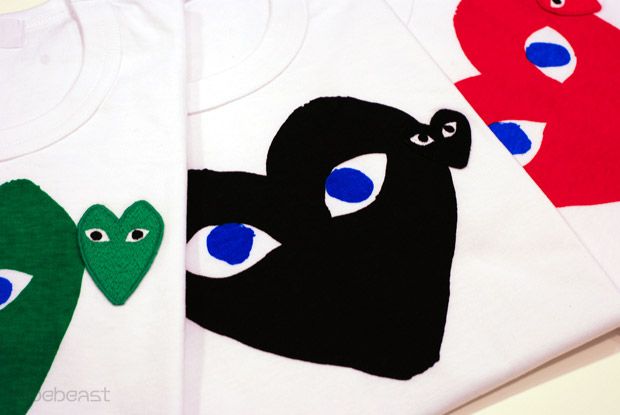
A red heart with eyes, drawn by artist Filip Pagowski,
became the logo that smiled where Rei had always frowned.
Simple cotton.
Classic cut.
A whisper of irony.
PLAY wasn’t mainstream — it was Rei’s wink to a generation raised on minimalism.
And it connected globally: Tokyo, Paris, London, New York.
Collaborations poured in:
Nike, Supreme, Converse, Louis Vuitton —
each adding to her mythology, never diluting it.
PLAY made Comme Des Garcons universal,
without ever making it ordinary.
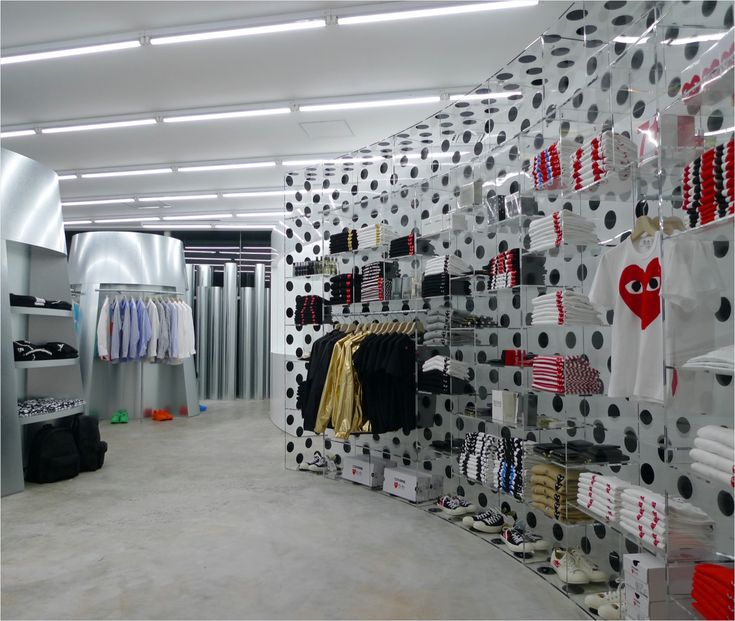
🌍 Dover Street Market: Where Fashion Becomes Experience
Rei and her husband, Adrian Joffe, opened Dover Street Market in London.
Not a boutique.
Not a store.
A collision space.
Every corner transformed seasonally.
Every rack was installation art.
Every visitor became a participant.
Rei called it “beautiful chaos.”
And that’s exactly what it was —
a living museum for global design,
from Gucci to Raf Simons to Sacai,
curated with her instinct for contradiction.
🕯️ 2010s: Rei, The Sculptor of Emotion
By the 2010s, Rei had transcended the limits of fashion entirely.
Her collections became performance art —
dresses constructed from wire, foam, plastic,
defying gravity,
challenging the notion of human form.
In 2017, The Met honored her with
“Rei Kawakubo / Art of the In-Between.”
Only two living designers have ever been given solo exhibitions there.
Rei was one.
Her work hung in silence —
a dialogue between creation and void.
The world finally understood:
Comme Des Garcons was not clothing.
It was consciousness, shaped by cloth.
🖤 Tokyo, Eternal
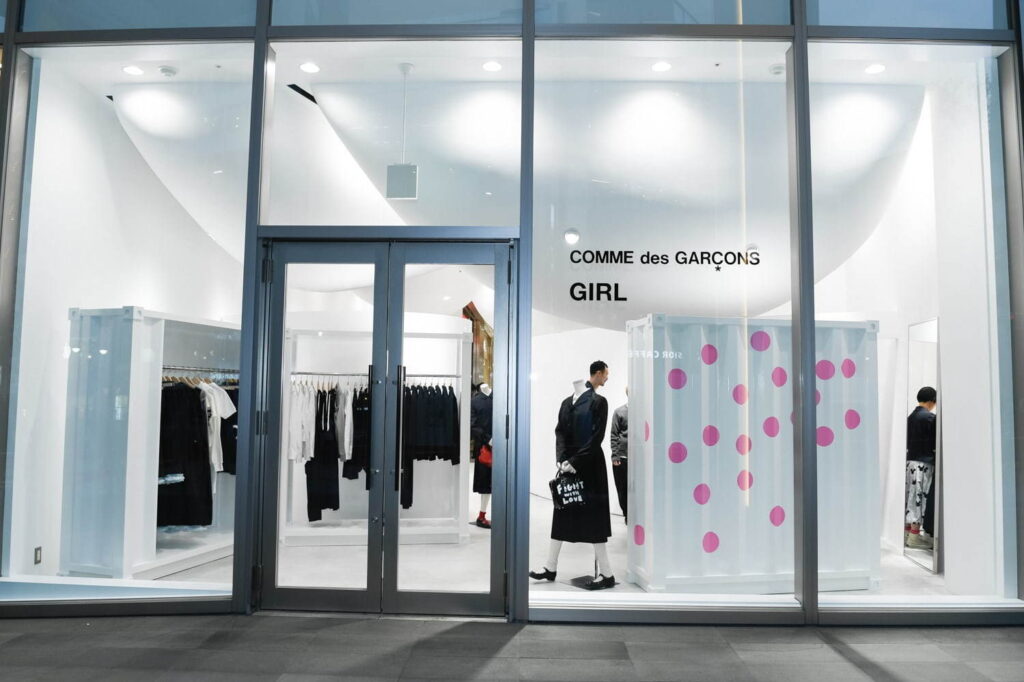
Today, walk through Aoyama,
and the spirit of Rei still lingers.
The architecture whispers minimalism.
The boutiques radiate restraint.
The youth — layered, abstract, self-aware — move like shadows in her lineage.
From Shibuya’s chaos to Koenji’s thrift revolution,
the DNA of Comme Des Garcons runs through Tokyo’s veins.
It’s no longer about rebellion.
It’s about freedom through awareness.
✴️ The Legacy of Rei Kawakubo
Rei remains one of fashion’s last true enigmas.
She speaks rarely.
She smiles only when she must.
But her silence says everything.
“Creation is about what doesn’t exist,” she once said.
“I want to create something that has never existed before.”
And she did.
Not once. Not twice.
But every single season.
Her influence ripples through Margiela, Rick Owens, Vetements —
every designer who dares to question the system owes her a quiet bow.
🪞 Beyond Japan, Beyond Time
Comme Des Garcons began in Tokyo.
But it doesn’t belong to Tokyo anymore.
It belongs to every mind that refuses to obey.
Every designer who builds instead of copies.
Every person who sees beauty in what others call broken.
Rei Kawakubo didn’t just change fashion.
She changed how we think about form, identity, and freedom.
💫 Final Words
Fashion’s history is written in silk and sequins.
But Rei Kawakubo wrote hers in silence and black cotton.
From Tokyo’s underground to the temples of Paris,
from The Crows to Dover Street Market,
her revolution never needed noise —
just vision.
Because in the end,
Comme Des Garcons isn’t a label.
It’s a language.
And Tokyo was the first to speak it.