I. A DIFFERENT KIND OF BEGINNING
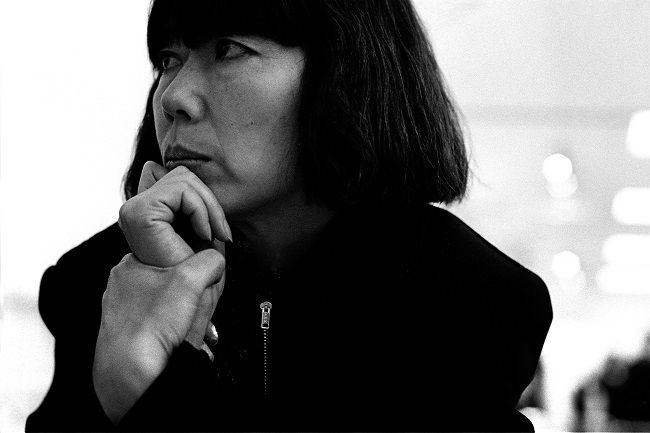
When Rei Kawakubo founded Comme des Garçons in Tokyo in 1969, she did not imagine a global empire.
She imagined freedom.
Armed with a degree in Fine Arts and Literature rather than pattern-making, Kawakubo entered fashion through ideas, not technique.
Her label’s French name — “like boys” — signaled rebellion: clothes that refused gender rules, beauty standards, and Western expectations of luxury.
Tokyo at the time was obsessed with bright color and pop culture optimism. Kawakubo offered black, asymmetry, and silence.
The first garments were cut roughly, edges raw, seams exposed — honest construction instead of decoration.
By the mid-1970s, a quiet cult had formed around her tiny Aoyama studio.
Students and artists wore Comme des Garçons like armor against conformity.
In Japan’s economic boom, Kawakubo designed an antidote: austerity as authenticity.
II. 1981: THE PARIS SHOCK
When Comme des Garçons debuted at Paris Fashion Week in 1981, the reaction bordered on outrage.
The audience expected chic silhouettes.
Instead, they saw black wool torn open, loose layers, and shapes that distorted the body.
No music, no smiles, no glitter.
French critics called it “Hiroshima Chic.”
Yet to a new generation, it was revelation.
Kawakubo’s message was not destruction but liberation — from prettiness, from the male gaze, from Western definitions of perfection.
“Fashion should not always be comfortable,” she said. “It should make you think.”
Together with Yohji Yamamoto and Issey Miyake, she led what became known as the Japanese Wave in Paris — minimalism charged with emotion and intellect.
III. THE LANGUAGE OF IMPERFECTION
Throughout the 1980s, Comme des Garçons defined the vocabulary of deconstruction.
Every season was a question, not a statement.
| Year | Collection | Concept |
|---|---|---|
| 1982 | Destroy | Torn fabrics as memory of creation |
| 1983 | Body Meets Dress, Dress Meets Body | Padding and distortion challenging ideal form |
| 1986 | Homme Plus | Menswear unbound from tradition |
Clothes were ripped, padded, unfinished.
Models walked like sculptures — emotionless, beautiful in resistance.
Kawakubo didn’t chase trends; she dismantled them.
In doing so, she influenced designers from Martin Margiela to Rick Owens, shaping the modern notion that imperfection can be luxury.
IV. THE 1990s: AN EMPIRE OF CONCEPTS
While many designers expanded through marketing, Kawakubo expanded through ideas.
She launched parallel lines, each exploring a fragment of her philosophy:
- Tricot Comme des Garçons — knitwear with quiet rebellion.
- Homme Deux — minimal tailoring for modern men.
- Junya Watanabe Comme des Garçons — her protégé’s experimental spinoff (1992).
- Comme des Garçons Parfum — scents that smelled of tar, metal, and air.
Her first fragrance, released in 1992, was deliberately anti-floral — a scent built from industrial notes to provoke rather than please.
“I wanted a perfume that smells abstract,” she explained, “like nothing familiar.”
By the end of the decade, Comme des Garçons was no longer one label but a creative ecosystem, a conversation between disciplines — fashion, fragrance, art, and architecture.
V. A HEART WITH EYES: THE 2000s
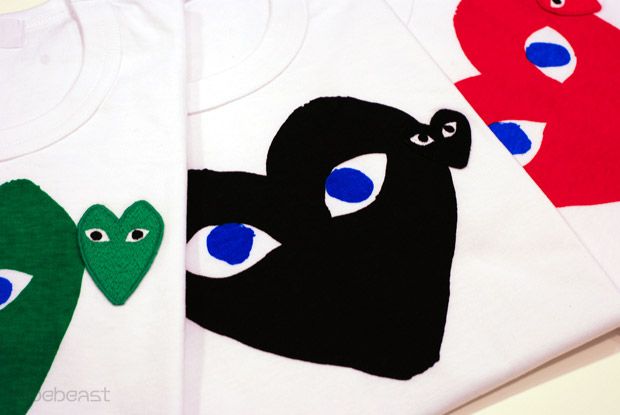
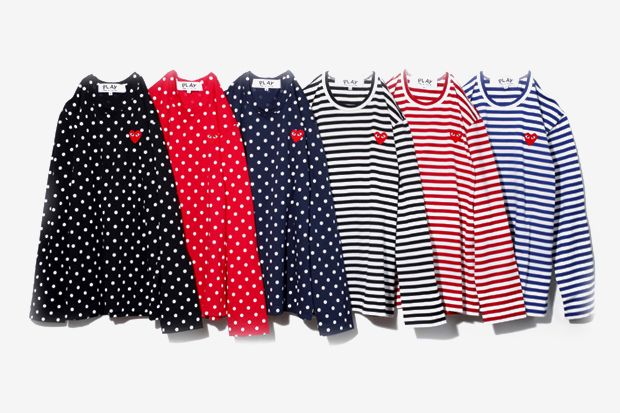
In 2002, the brand revealed a gentler side: Comme des Garçons PLAY.
Created with Polish artist Filip Pagowski, the logo — a red heart with eyes — became an icon.
PLAY introduced cotton T-shirts, striped knits, and collaborations with Converse, turning avant-garde philosophy into global pop culture.
The same decade saw another revolution: Dover Street Market (London, 2004).
More than a store, DSM was a curated environment built from scaffolding, plywood, and concept.
Luxury labels shared space with streetwear pioneers; installations changed every season.
Kawakubo called it “beautiful chaos.”
It became the blueprint for experimental retail worldwide.
VI. COLLABORATION AS CULTURE
Between 2000 and 2010, Comme des Garçons collaborated fearlessly — not to chase hype, but to explore contrast.
- Nike x Comme des Garçons — performance meets philosophy.
- Louis Vuitton x CDG — rebellion meets refinement.
- Supreme x CDG SHIRT — luxury meets street.
- H&M x CDG — accessibility without dilution.
Each partnership was treated as dialogue, not dilution.
It proved that conceptual fashion could coexist with mass appeal — without losing its soul.
VII. FASHION AS SCULPTURE: 2010 → 2020
By the 2010s, Kawakubo had transcended the boundaries of fashion.
Her shows became architectural experiments — sculptural garments built from foam, wire, paper, and felt.
Signature collections:
| Year | Title | Idea |
|---|---|---|
| 2012 | White Drama | Rituals of life — birth, marriage, death |
| 2014 | Not Making Clothes | Form beyond function |
| 2017 | Art of the In-Between | Dualities of existence, exhibited at The Met |
The Metropolitan Museum of Art honored her with a solo exhibition in 2017 — the first living designer since Yves Saint Laurent to receive such recognition.
Visitors walked through white chambers filled with her creations, each exploring contradiction:
order / chaos, object / body, presence / absence.
Critics called it “a museum inside a mind.”
VIII. THE 2020s: STILL REBELLIOUS
Even in the digital era, Comme des Garçons resists algorithms.
The brand ignores social-media trends, refusing to simplify its ideas for clicks.
Recent menswear and womenswear shows — “Metal Outlaw” (2021), “Black Rose” (2023), “In-Between Worlds” (2024) — continue to examine isolation, strength, and renewal.
While others seek clarity, Kawakubo seeks questions.
Her Tokyo studio remains the brand’s heartbeat — silent, minimalist, devoted to creation.
“The world is noisy,” she once said. “I prefer the sound of thinking.”
IX. JAPAN × FRANCE: TWO WORLDS, ONE LANGUAGE
The genius of Comme des Garçons lies in its cultural duality.
| Element | Japanese Essence | French Influence |
|---|---|---|
| Philosophy | Wabi-sabi: beauty in imperfection | Couture discipline and drama |
| Emotion | Restraint and meditation | Expression and romance |
| Method | Concept first, design second | Technique first, presentation second |
Kawakubo doesn’t merge them; she lets them collide.
The result is balance through opposition — a uniquely global aesthetic that feels timeless yet experimental.
X. REI KAWAKUBO: THE MIND BEHIND THE MYTH
Rei Kawakubo remains as elusive as ever.
She rarely grants interviews and seldom explains her work.
When asked about meaning, she answers with silence — or a short “I don’t know.”
She sketches little. She builds directly on mannequins, allowing form to emerge organically.
Her process is tactile, emotional, almost meditative.
Behind the scenes, her partner Adrian Joffe manages the business operations, translating her vision into structure while preserving independence.
Together they’ve kept the company privately owned — a fortress of creative control in an industry dominated by conglomerates.
XI. LEGACY AND INFLUENCE
Fifty-plus years on, Comme des Garçons stands as both fashion house and philosophical movement.
Designers such as Martin Margiela, Ann Demeulemeester, Rick Owens, Demna Gvasalia, and Virgil Abloh cite Kawakubo as a formative influence.
Her contributions to gender-neutral fashion, conceptual retail, and performance-based runway presentation have reshaped how the world experiences clothing.
Museums, curators, and scholars now study her work as art history — not commerce.
XII. BEYOND BEAUTY
Perhaps Kawakubo’s greatest achievement is redefining what beauty can be.
She reminds the world that fashion is not about decoration but discovery — a reflection of the human condition, with all its contradictions.
Her brand rejects perfection but embraces emotion.
Rejects clarity but celebrates meaning.
“The future of fashion,” she says, “is to create something that does not yet exist.”
XIII. CONCLUSION — THE ART OF NEVER FITTING IN
From a small Tokyo apartment to the stages of Paris, Rei Kawakubo built an empire on disobedience.
Comme des Garçons remains untouchable because it refuses to be understood completely.
It exists in the in-between:
Japan and France.
Art and commerce.
Chaos and order.
And that space — undefined, uncomfortable, revolutionary — is exactly where beauty lives.